Custom Hoodies in Canada: How to Order Hoodies for Your Team or Company
Posted on 13 November 2026
Key Takeaways
- Custom hoodies are fleece sweatshirts with a hood that carry your logo or design, added by screen printing, embroidery, or a heat-applied transfer.
- Pick the style for how people will wear it: a pullover gives you the biggest front print, and a full-zip suits staff who layer and pairs best with a left-chest logo.
- Midweight fleece, roughly 250 to 350 GSM, suits most Canadian team orders, and heavier fleece is worth it when the hoodie replaces a jacket.
- On a dark hoodie, light ink usually needs a white base layer printed first, so the hoodie colour you pick affects the price as well as the look.
- Allow about three weeks from your first message to hoodies in hand, and approve your proof by the third week of November for December delivery.
Ordering hoodies for a team raises a few questions pretty quickly. Zip-up or pullover? Lightweight or heavyweight fleece? Screen printing or embroidery? And what do you do when half the team hasn't sent in their sizes? The answers affect how the hoodies fit, feel, hold up to regular wear, and what you'll pay per piece. At R&P Prints Canada, we've been printing and embroidering wholesale custom hoodies in our Toronto shop since 1999, so we know which details are worth sorting out before production starts.
Custom hoodies are hooded fleece sweatshirts decorated with your own logo or design, usually ordered as a batch so a whole team or staff group wears the same piece. The right combination depends on who'll be wearing the hoodies, how they'll use them, and what your budget allows.
Pullover or Full-Zip: Match the Style to How People Wear It
Choose a pullover if you want a large front print, and a full-zip if people will wear the hoodie open or over a uniform. A pullover's unbroken front panel gives you the most room for a big design, and it usually costs a little less because there's no zipper to sew in. A full-zip is easier to take on and off indoors. Because the zipper splits the front in two, the logo sits on the left chest and the large graphic moves to the back.
Fleece Weight: What GSM Means for Warmth
The weight of a hoodie's fleece affects how warm and thick it feels. You'll usually see this measured in GSM (grams per square metre), although some brands use ounces instead. An 8-ounce fleece, for example, is roughly 270 GSM.
Here's how the weights compare:
- Under 250 GSM (lightweight): Better suited to indoor wear or layering under a jacket.
- 250 to 350 GSM (midweight): A practical year-round choice for team hoodies, offering warmth without feeling too heavy.
- Over 350 GSM (heavyweight): Thicker fleece suited to cooler weather, especially when the hoodie is worn as an outer layer.
There's no official standard for what counts as lightweight or heavyweight, so check the GSM listed in the garment specifications rather than relying on the label alone.
Choosing a Hoodie Blank: Fabric Matters More Than the Label
R&P Prints carries hoodies from brands including Gildan, Bella+Canvas and ATC, with different fabric weights, fits and price points. Before settling on a brand, check what the hoodie is made from and how it will be worn. You can compare available styles and colours in our custom fleece collection.
Most team hoodies use a cotton-polyester blend, often 50/50 or 80/20. Cotton gives the fleece a soft feel, while polyester helps it hold its shape and resist shrinking. These are the same fabric differences to consider when choosing the right t-shirt fabric, especially when ordering apparel that will be worn and washed regularly.
The fabric also affects how your logo prints. Some dark or brightly coloured polyester blends can release dye when heated, causing it to bleed into lighter ink and change the printed colour. This is called dye migration. Choosing inks suited to the fabric is important, although some garments may need specialized low-bleed inks or a different printing approach. Tell us which hoodie and colour you're considering so we can check the printing requirements before production.
Screen Printing vs Embroidery on Fleece
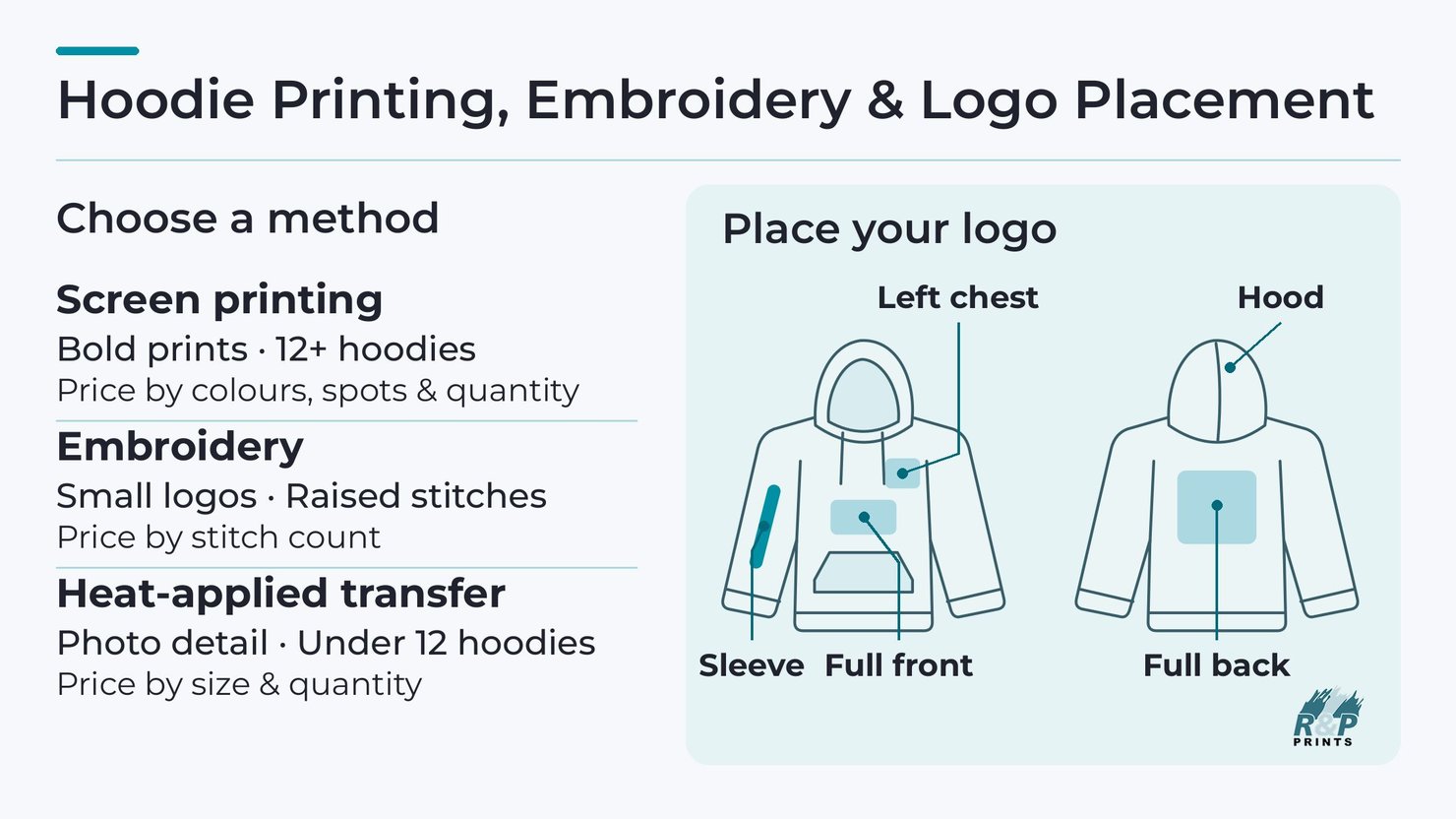
Both methods work well on hoodies, and the right one depends on your logo and the look you're after. Custom screen printing pushes ink through a fine mesh screen, one screen per colour, which makes it the most economical way to put a large, bold design on a run of hoodies. Many first-time buyers don't know that light ink on a dark hoodie usually needs a white base layer printed first. We call it an underbase, and it keeps the colour bright instead of letting it soak into the fabric.
Custom embroidery stitches your logo into the fabric for a raised, textured finish that looks sharp on a company hoodie. We digitize the artwork in-house and send you a digitized proof before anything is stitched. Because embroidery is priced on stitch count, a left-chest logo is affordable while a full-back design gets heavy and expensive. We also keep stitching clear of the kangaroo pocket, which would otherwise be sewn shut. Here's how the main options compare on a hoodie.
Method | Best suited to | How the price is set | What to watch for |
|---|---|---|---|
Screen printing | Bold logos and large front or back prints on runs of a dozen or more | Number of ink colours, print locations and total quantity | Light ink on a dark hoodie usually needs an underbase, which adds to the cost. |
Embroidery | Small left-chest logos and a polished look for staff or client gifts | Stitch count, which grows with the size and detail of the logo | Very fine text and tiny details can blur in thread, so the digitized proof matters. |
Heat-applied transfer | Full-colour or photo-realistic artwork and orders under 12 pieces | Size of the transfer and the number of pieces | It sits on top of the fleece, so it feels different from ink printed into the fabric. |
Where Your Logo Can Go on a Hoodie
Every extra location adds a little to the price, so it pays to decide them before you ask for a quote. These are the spots we decorate most often:
- Full front: A large graphic centred on the chest, kept above the kangaroo pocket so the pocket seam doesn't cut through it.
- Left chest: A small logo around 8 to 10 centimetres wide that works on pullovers and zips alike, and the classic spot for embroidery.
- Full back: The biggest print area, measured from just below the hood, and the best place for a team name or a large brand mark.
- Sleeve or hood: A short line of text down the arm or a small mark on the side of the hood, which adds a detail people notice later.
Our favourite combination for teams is a left-chest logo with a big print on the back. For more placement ideas, see our post on branded hoodies for business.
How Pricing Works on a Bulk Hoodie Order
Our minimum is 12 pieces per design, and there are no setup fees, so your quote covers the hoodies and the decoration. Four things set the price per hoodie: the blank you choose, the number of ink colours or the stitch count, the number of print locations, and the total quantity.
Forty-eight grey hoodies with a one-colour black logo on the left chest will cost far less per piece than twelve hoodies with a four-colour front print and a back print, because the second order uses more screens and locations and spreads that work over fewer pieces. If you need a budget approved, ask us to price two versions, such as a one-colour and a full-colour logo. If your logo has specific brand colours, mention them up front, and check them on the proof before you approve it.
Sizing a Team Order Without the Guesswork
If you're the one organizing the order, sizing is the part most likely to go sideways. Collect a size from each person with a short form or a shared sheet instead of guessing from a headcount. Since most hoodies are cut unisex, ask people to choose the size they'd pick in a men's sweatshirt, and offer a fitted women's style if your group would like one. Many people size up one step because hoodies go over a shirt or uniform, and a couple of spares in your most common sizes will cover new members.
Artwork, Proofs and Reorders
The best file to send is a vector logo file, such as an AI, EPS or vector PDF, because it scales to any print size without going blurry. If all you have is a small image from a website or an email signature, mention it before you order. We'll sort out a clean version with you and confirm whether that affects the quote. Every order gets a proof showing exactly where and how big the design will sit, and it's worth a careful look at the spelling and placement before you approve it. Once your hoodies arrive, jot down the hoodie style, colour, and ink colours, because that makes next season's reorder much easier to match.
Common Hoodie Ordering Mistakes
Most problems with a team hoodie order come from a few decisions made too quickly:
- Guessing sizes from a headcount leaves you with too many larges and not enough smalls, so collect real sizes first.
- Choosing the hoodie colour after the design is final can mean an underbase you didn't budget for, so decide the two together.
- Sending a low-resolution logo slows down the proof and can soften the print, so find the original vector file early.
- Planning a full-front print on a zip hoodie doesn't work, because the zipper runs through the middle of the design.
Keeping Custom Hoodies Looking New
When the boxes arrive, pass a few care tips on to your team. Washing hoodies inside out in cold water protects the print, and tumble drying on low or hanging them up helps too, because high heat is hard on both ink and fleece. Skip bleach, and never iron directly over a print or an embroidered logo. If a symbol on the care label is unclear, the Government of Canada's guide to apparel and textile care symbols explains each one.
Ordering in Time for the Holidays
Production typically takes 5 to 10 business days after you approve the proof, and the proof usually goes out within a day or so of receiving your artwork. Shipping time depends on where in Canada the order is headed, and about three weeks from your first message to hoodies in hand is a realistic window. For a December gift or holiday event, that means approving your proof by the third week of November, which also leaves room for a second proof if the logo needs a tweak.
Planning a Bulk Hoodie Order?
R&P Prints Canada has printed and embroidered hoodies for teams, companies and schools since 1999, all in our own Toronto shop, with Canada-wide shipping and free shipping on qualifying orders. Send us your logo, the hoodie you have in mind and a rough headcount by size, and we'll come back with pricing and a proof. Call 1-877-646-5111 or get a free online estimate at printscanada.com, and if a crewneck suits part of your group better, take a look at our custom sweatshirts too.
Frequently Asked Questions
What Is the Minimum Order for Custom Hoodies?
Our minimum is 12 hoodies per design, which covers most teams and offices. You can mix sizes within those 12, and on most styles you can mix colours too, as long as the design stays the same. The price per piece drops as your quantity grows, since the screens are made once and shared across the run. If you need fewer than 12, tell us the quantity and design, and we'll suggest the most practical option, often a heat-applied transfer.
What Fleece Weight Is Best for a Canadian Winter?
Midweight fleece, from about 250 to 350 GSM, is the best all-round choice for a team hoodie worn indoors and under a coat through a Canadian winter. If the hoodie will be the main outdoor layer, at a job site or on the sidelines of a fall game, choose a heavier fleece above about 350 GSM. Heavier fleece feels warmer and more substantial but costs more per piece, which makes it the right call for groups who'll spend real time outside.
Why Does a White Logo on a Black Hoodie Cost More?
Light ink on a dark hoodie usually needs a white base layer printed underneath, so the colour stays bright instead of sinking into the fabric. That base layer is an extra screen and an extra pass on press, which adds a little to the cost per piece, while a dark logo on a light hoodie usually skips that step. If your brand colours allow it, ask us to price both versions before you choose a hoodie colour.