Embroidery vs Screen Printing: Which Is Right for Your Logo?
Posted on 29 September 2026
|
AT A GLANCE
|
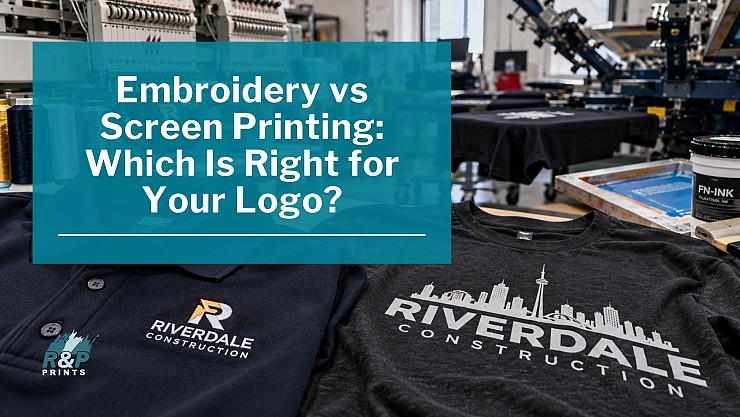
Embroidery is a decoration method that sews a design into a garment with thread, following a digitized stitch file, so the logo becomes a raised, textured part of the fabric itself. Screen printing pushes ink through a mesh stencil onto the surface of the garment, one colour at a time, and cures it with heat so it bonds to the fibres. Both produce a durable branded garment; they differ in how the logo looks, how it feels, which garments they suit, and how the price is built.
R&P Prints Canada has done both under one roof in Toronto since 1999, so we’re not trying to steer you toward one or the other. We’re asked the embroidery versus screen printing question on most first orders, and the honest answer depends on four things: the garment, the logo, the quantity, and how long the piece has to last. This guide works through each of them, then puts the answer in a table you can use before you request a quote for custom embroidery or printing.
How Do Embroidery and Screen Printing Actually Differ?
The difference starts with what each method puts on the garment. The Oxford English Dictionary defines embroidery as ornamenting fabric with needlework, and on a commercial machine that needlework is thousands of individual stitches in polyester or rayon thread, placed by a stitch file that tells the needle exactly where to go. The result sits on top of the fabric with real depth, and you can feel it under your thumb.
Screen printing puts down ink instead of thread. The Tate describes a screenprint as an image made by forcing ink through a stencil supported on a mesh screen, and on apparel that means one screen per colour, a squeegee pull for each, and a trip through a dryer to cure the ink. The print is flat, smooth and part of the surface. If you’d like the full process, our guide to how silk screen printing works walks through all eight steps.
That physical difference drives every other decision in this guide, because thread has weight and wants a garment that can carry it, while ink has coverage and wants a smooth surface and a design with area. Neither is better in the abstract, and a shop that tells you otherwise is usually selling the method it happens to own.
Which Garments Suit Embroidery, and Which Suit Screen Printing?
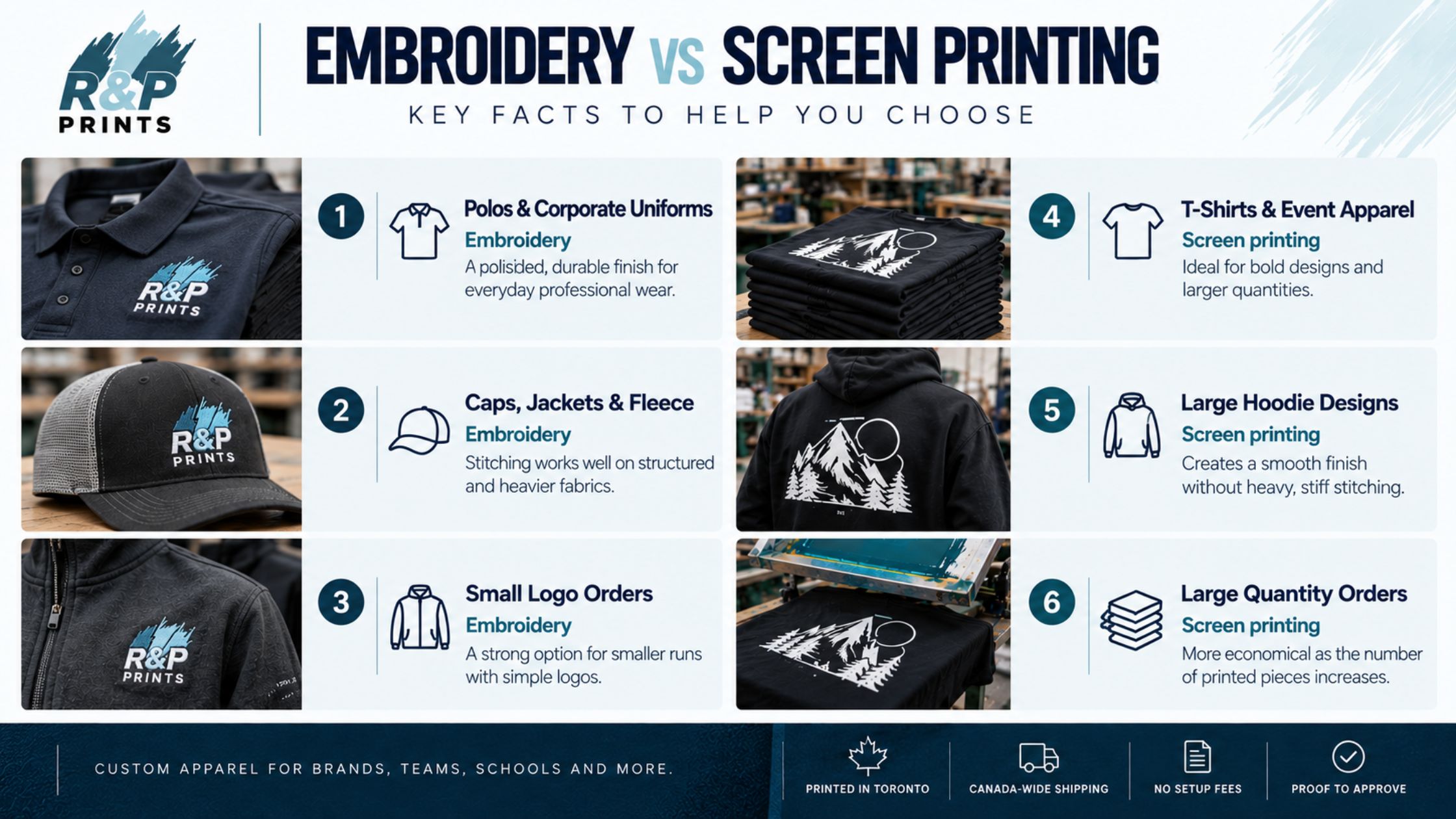
Start with the garment, because it decides more than the logo does. Embroidery needs a fabric with enough body to hold stitches without puckering, and it looks best where the logo is small and the garment is worn repeatedly. That’s why our most-requested embroidery pieces are custom polo shirts for staff and client golf days, custom caps and headwear with a front or side logo, and custom jackets and outerwear such as softshells, quarter-zips and fleece.
Screen printing wants a smooth, flat surface and rewards designs with size. A lightweight cotton t-shirt, a hoodie with a full front print, a tote bag, a run of event shirts with a large back graphic: these are screen printing jobs, and stitching a ten-inch design onto a thin tee would leave it stiff and heavy. Screen printing is also the method for commercial screen printing for uniforms where the same bold logo repeats across hundreds of pieces.
A few garments go either way, and the heavyweight sweatshirt is the usual example, since it can take a small embroidered left-chest logo or a large printed front, and the choice comes down to the look you want. Performance polyester polos embroider well but need the right backing and thread tension, which is one of the reasons we match thread and stabilizer to each garment rather than running one setting for everything.
Which Method Suits Your Logo?
Once the garment is settled, look at the logo itself. Embroidery renders solid shapes, clean type and bold marks beautifully, and it gives them a finish that reads as premium from across a room. It struggles with three things: very fine lines, tiny lettering, and gradients. Thread has a physical width, so a hairline in the artwork becomes a single row of stitches and small text under about a quarter inch tall turns to mush. Gradients can be suggested with blended thread colours, but they never look like a printed fade.
Screen printing handles fine detail, large flat areas and Pantone-matched brand colours with ease, and it can reproduce halftones and simulated-process artwork that embroidery simply cannot. Its limit is the opposite one: every colour is another screen, so a logo with eight colours costs more to print than a logo with two, and a design that relies on photographic realism is usually a job for direct-to-film transfer rather than either method.
If your logo has fine detail you don’t want to lose, ask for a stitch-count estimate before committing to embroidery. When we digitize a logo we can usually simplify the small elements so it stitches clean, but that’s a change you should see in the proof, not discover on the finished polo.
How Does Quantity Change the Answer?
Both methods carry the same 12-piece minimum at R&P Prints Canada, but they scale differently from there. Screen printing has a fixed setup per design, one screen per colour, so the per-piece price drops steadily as the run grows and a 250-piece order costs far less per shirt than a 24-piece one. Screen printing is the method built for volume, and the pricing reflects it.
Embroidery has almost no setup once the logo is digitized. Each piece takes the same number of stitches whether it’s the first cap or the four-hundredth, so the price per piece falls more gently with quantity. That makes embroidery the sensible choice for a dozen staff polos or twenty caps, where screen printing’s setup would be spread across too few pieces to help.
The crossover is roughly where your run gets large and your design gets big. A 300-piece event tee with a chest and back print is a screen printing job. Thirty polos with a left-chest logo is an embroidery job. A hundred hoodies with a small logo could be either, and the deciding factor becomes the look and the durability you need.
Which Lasts Longer, Embroidery or Screen Printing?
Both outlast the garment when they’re done properly. A properly cured screen print survives hundreds of washes without cracking, and an embroidered logo with the right backing survives just as many without fraying. The real difference is in how the two methods age, because thread doesn’t fade, and it doesn’t crack, so an embroidered polo worn and washed weekly for two years still looks like it did on day one. That’s why corporate wear, hospitality uniforms and anything a customer will see every day tend to be embroidered.
A screen print holds its colour well but takes more abuse from hot dryers and rough washing, and a large print on a thin tee will eventually show wear at the edges. For a garment worn to an event, sold as merch or replaced each season, that’s a non-issue. For a manager’s polo that has to look sharp for three years, thread is the safer investment.
What Does Each Method Cost?
The two methods are priced on different things, which is why a quote for each can come back looking so different. Embroidery is priced on the stitch count and complexity of the design plus the quantity. A small, simple left-chest logo has a low stitch count and costs less per piece than a large multi-colour crest, and the price falls as the quantity climbs. There is no setup fee, and the digitizing is done in-house.
Screen printing is priced on the quantity, the number of ink colours, and the number of print locations, such as a front, a back and a sleeve. Volume drives the per-piece price down sharply, each extra colour or location adds to setup, and Pantone matching is available for brand colours that have to be exact. Our custom screen printing page explains each of those levers, and every quote we send is itemized so you can see what changes when you adjust the run.
|
The practical rule: small runs of small logos on structured garments favour embroidery on price, and large runs of large designs on tees and hoodies favour screen printing. Send the artwork and the quantity and you’ll have both numbers within 24 hours. |
Embroidery vs Screen Printing: The Decision Table
Use this table to make the call before you request a quote. Where a row says “either”, the deciding factor is usually the look you prefer.
|
Your situation |
Better method |
Why |
|---|---|---|
|
Staff polos, golf shirts or a corporate uniform |
Embroidery |
A small stitched logo reads as premium and holds up to daily wear and weekly washing for years. |
|
Caps, beanies and other headwear |
Embroidery |
Structured headwear takes stitches cleanly, and a printed cap logo tends to look temporary. |
|
Jackets, softshells, quarter-zips and fleece |
Embroidery |
Heavy fabrics carry thread well, and ink sits poorly on textured or water-resistant surfaces. |
|
T-shirts for an event, a team or a product launch |
Screen printing |
Bold colour at volume, with a per-piece price that drops as the run grows. |
|
Hoodies with a large front or back design |
Screen printing |
Large designs would be stiff and heavy in thread, and ink gives a smooth, bold finish. |
|
Tote bags and giveaway merchandise |
Screen printing |
Single-colour prints on totes are fast, economical and look right for the item. |
|
A logo with fine lines, tiny lettering or gradients |
Screen printing |
Thread cannot hold hairlines or text under a quarter inch; ink can. |
|
A logo with eight or more colours |
Embroidery, or simplify it |
Each printed colour adds a screen, while thread colours cost nothing extra to change. |
|
Twelve to thirty pieces with a small logo |
Embroidery |
Almost no setup once digitized, so small runs price well. |
|
Hundreds of pieces with a big design |
Screen printing |
Setup is spread across the whole run and the per-piece cost falls. |
|
A heavyweight sweatshirt with a small chest logo |
Either |
Both work; choose by the finish you want and what the rest of your gear uses. |
Why Most Businesses End Up Using Both
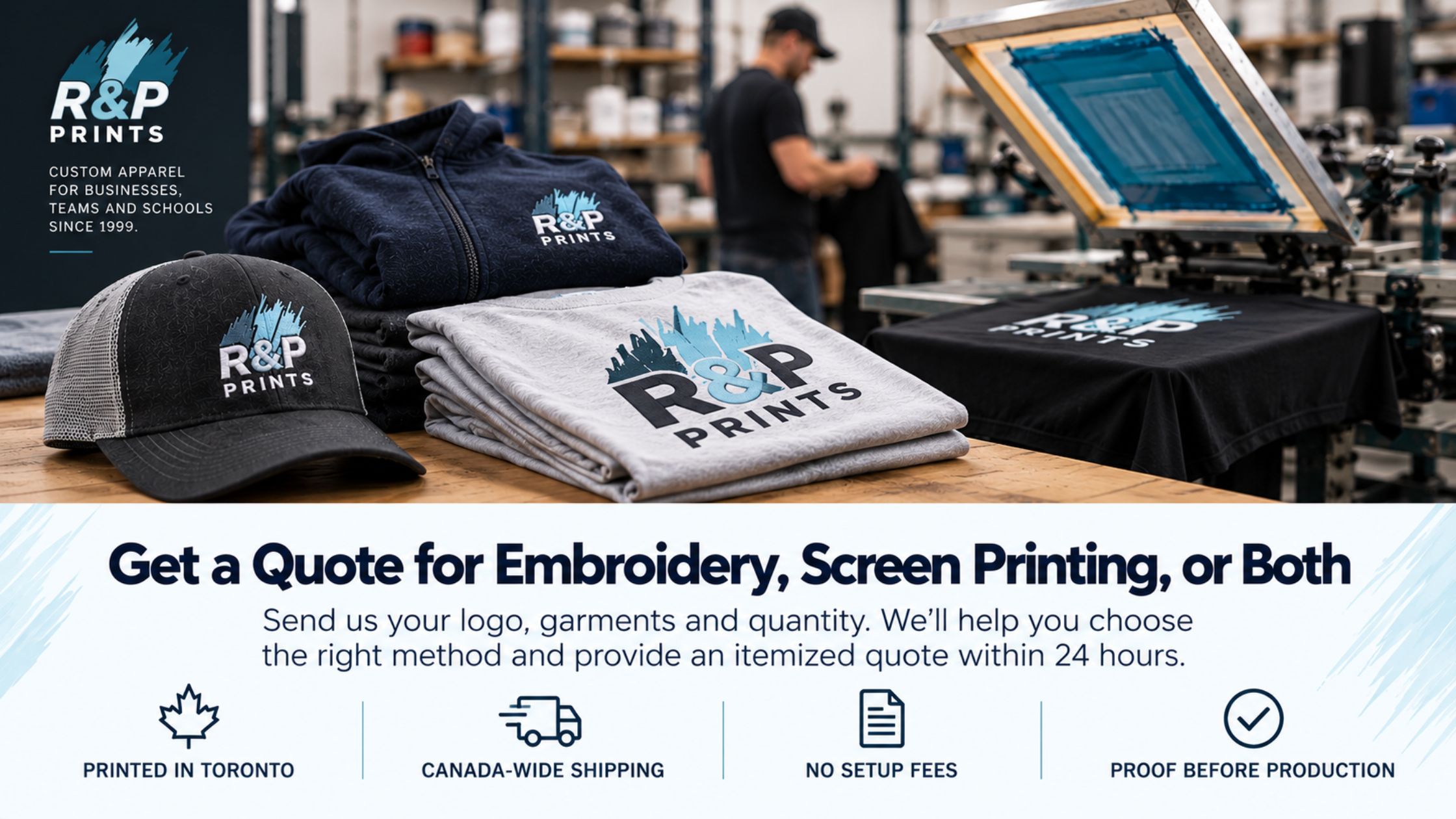
The companies we’ve worked with the longest rarely choose one method for everything. The staff wears embroidered polos and caps because those pieces have to look sharp every day, the summer event runs on screen printed tees because 300 of them need to be bold and affordable, and the winter jackets are embroidered because ink doesn’t belong on a softshell. The logo stays consistent across all of it because the same team digitizes and separates the same artwork.
That’s the advantage of a shop that does both in-house. There’s no incentive to push you toward the method that happens to be on the floor, the proof for either one comes from the same people, and a reorder of the polos and a first order of the tees can ship in the same box.
Get a Quote for Embroidery, Screen Printing, or BothR&P Prints Canada has embroidered and screen printed for Canadian businesses, teams and schools since 1999, all of it in our own Toronto shop and shipped free coast to coast. Send us your logo, the garments you’re considering and the quantity, and we’ll tell you straight which method suits each piece, with an itemized quote within 24 hours and a proof to approve before anything is stitched or printed. Call 1-877-646-5111 or request a free print estimate at printscanada.com |
Frequently Asked Questions
Is embroidery more expensive than screen printing?
It depends on the size of the design and the size of the order. Embroidery is priced on stitch count, complexity and quantity, so a small left-chest logo on a few dozen polos is economical because there’s no setup beyond the digitizing. Screen printing is priced on quantity, ink colours and print locations, so it becomes the cheaper method as the run grows and the design gets larger. For most orders under about 50 pieces with a small logo, embroidery comes out close to or below the printed price.
What is embroidery digitizing?
Digitizing is the step that converts your logo into a stitch file the embroidery machine can follow. To digitize is to convert something into a digital form, and in embroidery that means mapping every stitch, its direction, its density and the underlay beneath it, so the thread sits clean and the logo reads sharp instead of puckered. At R&P Prints Canada digitizing is done in-house, you approve the digitized proof before production, and the file is kept on record so reorders match the first run.
Can you embroider on a t-shirt?
Yes, within limits, and the limits matter. A small logo, around three to four inches wide on the left chest, embroiders well on a mid-weight or heavy cotton tee. Large designs, fine lettering and lightweight or stretchy fabrics are poor candidates because the stitches add weight and can pucker thin material. For a big front or back design on a t-shirt, screen printing gives a smoother, lighter and more economical result, and it’s the method we’d recommend for most tee orders.
Which method holds up better to washing?
Both hold up well when done properly, but they age differently. Embroidered thread doesn’t fade or crack, so a stitched logo on a polo or jacket looks the same after years of weekly washing, which is why uniforms and corporate wear are usually embroidered. A properly cured screen print survives hundreds of washes too, though a large print on a thin tee will eventually soften at the edges with heavy use. Wash inside out in cold water and both will last as long as the garment.
What is the minimum order for embroidery and screen printing?
The minimum at R&P Prints Canada is 12 pieces per design for both embroidery and screen printing. Embroidery needs the logo digitized once and then stitches each piece individually, so small runs price well right from the minimum. Screen printing needs a screen burned for every ink colour, so it’s most cost-effective as the quantity climbs, with price breaks that apply automatically on larger runs. If you need fewer than 12 pieces, tell us the quantity and design and we’ll recommend the most practical option.