Screen Printing 101: Understanding Silk Screen Printing and How It Works
Posted on 29 September 2025
|
AT A GLANCE
|
Silk screen printing is a printing method in which ink is forced through a fine mesh stencil onto a surface, one colour at a time, so that the design bonds directly into the material. On apparel it produces a thick, opaque layer of ink that stays bright through years of washing, which is why it remains the standard method for team shirts, staff uniforms and event merchandise.
R&P Prints Canada has printed this way in our Toronto shop since 1999, and the questions we hear from first-time customers haven’t changed much in that time. Customers want to know whether silk screening differs from screen printing, how the process actually works, what it costs, and when it’s the wrong choice for a job. This guide answers each of those in order, so you can decide whether custom screen printing suits your next order before you ask for a quote.
Is Silk Screen Printing the Same as Screen Printing?
Yes, they are one and the same method, and silk screen printing, screen printing, silkscreening and serigraphy all describe a single technique whose different names come from its history rather than any difference in how it’s done. The Tate defines a screenprint as a print made by pushing ink through a stencil supported on a mesh screen, and that definition covers a fine-art edition and a run of 500 team shirts equally well.
The word “silk” survives because the earliest screens were woven from silk. Today’s screens use polyester mesh, which costs less, resists stretching and holds a consistent thread count, so a printer can choose a coarse mesh for heavy ink coverage or a fine mesh for detailed line work. When a customer asks us for silk screening, we know they mean the same press and the same process as everyone else.
“Serigraphy” is the term the art world adopted in the 1930s to separate artist-made prints from commercial work. The Oxford English Dictionary traces it to the Latin for silk and the Greek for drawing, and you’ll still see it on gallery labels, but no apparel printer uses it on a quote.
Where Did Silk Screen Printing Come From?
The technique is roughly a thousand years old. According to the Western New York Book Arts Center’s history of screenprinting, stencil printing through mesh appeared in China during the Song Dynasty, was refined in Japan with paper stencils and mesh made from human hair, and reached Europe in the eighteenth century as silk became available for trade.
Two twentieth-century developments turned it into an industry. The first was the photo-reactive emulsion stencil of the 1930s, which let a printer transfer any artwork onto a screen with light instead of cutting it by hand. The second was the rotary garment press, which put several screens around a carousel so a shirt could receive one colour after another without moving off its platen.
Andy Warhol made the method famous in the 1960s. The Victoria and Albert Museum’s record of his Marilyn print shows the flat, saturated colour that only a screen can lay down, and it’s the same quality that makes a logo pop on a black hoodie today.
How Does Silk Screen Printing Work, Step by Step?
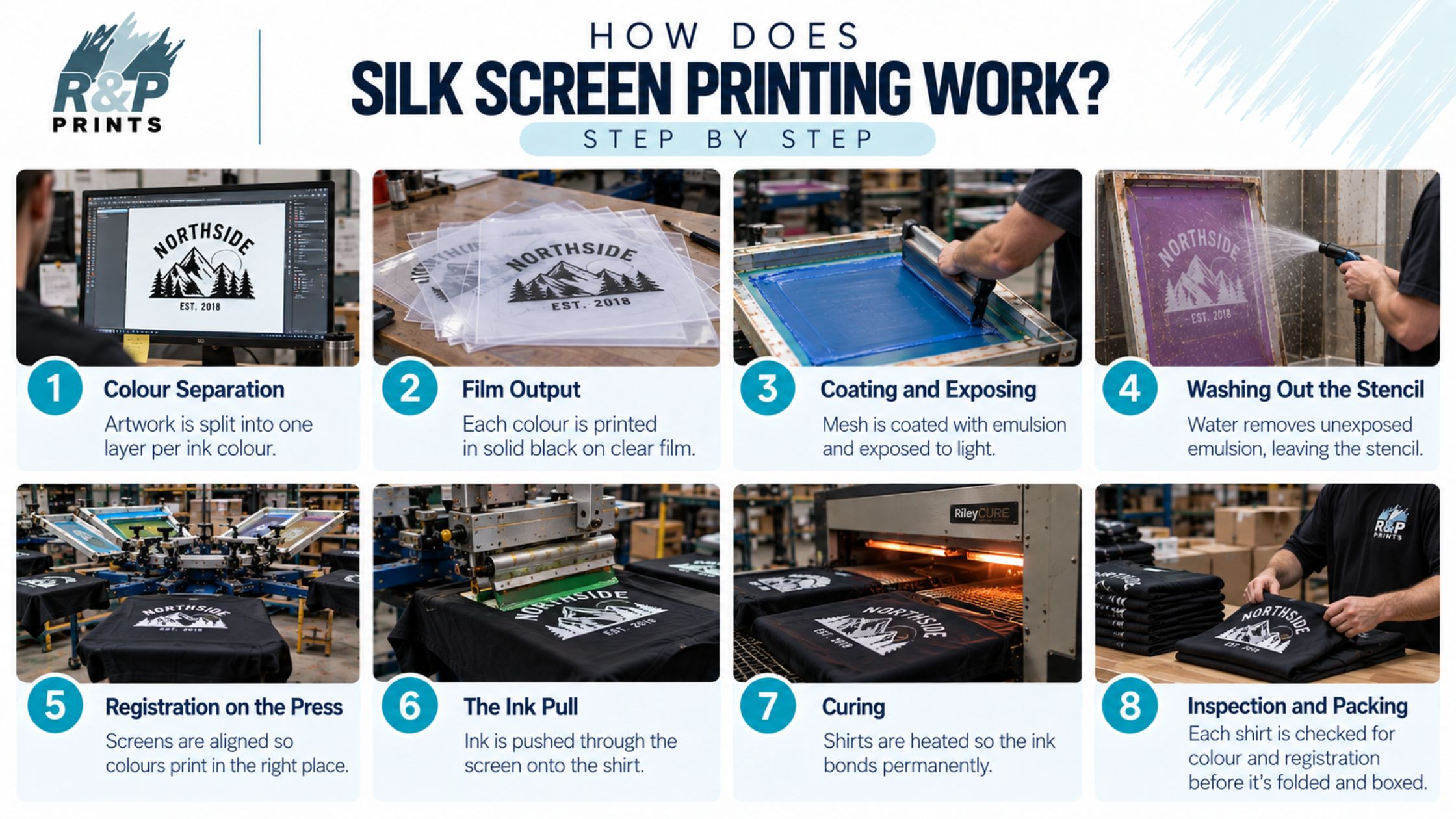
Every screen printed shirt goes through the same sequence, whether the order is 12 pieces or 12,000. The whole process, from a file arriving to a box leaving, is what we mean when we quote a turnaround of 5 to 10 business days from artwork approval.
Step 1: Colour Separation
The artwork is split into one layer per ink colour, because each colour prints from its own screen. A vector file separates cleanly; a flattened JPEG has to be redrawn first, which is why we ask for AI, EPS or PDF files whenever they exist.
Step 2: Film Output
Each colour layer is printed in solid black onto a clear film. Wherever the film is black, the screen will later be open, and wherever it’s clear, the screen will stay blocked.
Step 3: Coating and Exposing the Screen
The mesh is coated with light-sensitive emulsion and dried in the dark. The film is laid on top and the screen is exposed to strong light, which hardens the emulsion everywhere except under the black areas of the film.
Step 4: Washing Out the Stencil
Water rinses away the unexposed emulsion, leaving open mesh in the exact shape of the design. The screen is now a stencil, and it will be used for every shirt in the run.
Step 5: Registration on the Press
Each screen is clamped into the press and aligned so the colours land in the right place relative to one another. On a multi-colour job this is the step that separates a crisp print from one with a thin halo of misaligned ink.
Step 6: The Ink Pull
A shirt is loaded onto the platen, ink is spread across the screen, and a squeegee is pulled across it to push ink through the open mesh into the fabric. Plastisol ink is the industry default because it sits opaque on any garment colour; water-based ink soaks into the fibres for a softer feel on light shirts.
Step 7: Curing
The printed shirt passes through a conveyor dryer that heats the ink to the temperature at which it bonds permanently. Under-cured ink is the most common reason a print cracks or washes out, and it’s the step we watch most closely.
Step 8: Inspection and Packing
Every piece is checked for colour and registration before it’s folded and boxed. If a shirt fails that check, we reprint it. That’s the deal we make on every run.
What Is Silk Screen Printing Best For?
The method’s strengths all follow from the thick layer of ink it lays down. Solid colours come out opaque, even light ink on a black garment, and Pantone matching holds across the whole run because the ink is mixed once to a formula. The print survives hundreds of washes without the fading that thinner methods show. And because the setup is done once per screen, the price per shirt drops as the quantity rises.
That makes it the right choice for bulk t-shirt printing with a one- to four-colour logo, for custom hoodies and sweatshirts where a heavy front print needs to hold up to daily wear, and for any order where the same design repeats across dozens or thousands of garments. Beyond apparel, the same screens print tote bags, posters and signage.
The technique also supports more than flat spot colour. Halftone printing builds shading out of tiny dots, simulated process uses several spot colours to imitate a photograph on a dark shirt, and four-colour process uses the cyan, magenta, yellow and black inks that the Federal Agencies Digital Guidelines Initiative defines as the standard subtractive printing set. Each of those techniques adds screens to the job, and every added screen adds to the cost.
What Are the Disadvantages of Silk Screen Printing?
An honest answer is more useful than a sales pitch here, because we send jobs to other methods every week, and screen printing has three real limits that decide when we do.
The first limit is the quantity a run needs to justify its setup. A set of screens has to be made for each design, so a run under our 12-piece minimum spends more on setup than it saves on printing. Direct-to-film transfer, which prints the design onto a carrier film and heat-presses it onto the garment, is usually the better option below that number.
The second limit is how much fine detail a screen can hold. Fine gradients, drop shadows and photo-real images push the method into simulated process, which needs skilled separations and several screens. For a small, full-colour job, direct-to-garment or direct-to-film printing reproduces that detail with less setup, and our comparison of screen printing versus heat transfer walks through where each one wins.
The third limit is the number of ink colours a design carries. Each ink colour is another screen to burn, register and clean, so a six-colour design costs more per shirt than a two-colour version at the same quantity. Most logos print better with fewer colours anyway, and we’ll show you a simplified option in the proof if we think it will serve the order.
How Much Does Silk Screen Printing Cost?
Three factors set the price on every screen printing quote: how many pieces you order, how many ink colours are in the artwork, and how many locations you print, such as a front, a back and a sleeve. There are no setup fees at R&P Prints Canada, and bulk discounts apply automatically as the quantity climbs, with visible price breaks at 50, 100 and 250 pieces.
Two optional charges are worth knowing about before you send artwork. A specified Pantone match costs $35 per colour and guarantees your brand colour stays consistent across the run. Artwork that has to be redrawn into vector form is billed at $55 an hour, which is easy to avoid by sending the original design file rather than an export. Our guide to design file red flags covers the file problems that trigger that charge.
|
Because every quote is itemized, you can see exactly what changes when you add a colour or drop a print location. Send the artwork and the quantity and you’ll have the numbers within 24 hours. |
What Do I Need to Order Silk Screen Printing?
Four things, and none of them require design software. You need the artwork in the best form you have, ideally a vector file and at minimum a 300 DPI image sized to the final print. You need the Pantone codes for your brand colours if exact matching matters. You need a quantity broken down by garment size. And you need the date the shirts have to arrive, so we can confirm the timeline before you commit.
From there the process runs on our side. We check the file, send a digital proof showing the design at its actual size on the garment colour you chose, and start production only after you approve it. Everything prints on our own presses in Toronto and ships to every province, with free economy shipping on qualifying orders. For a broader explanation of the method and where it fits among the alternatives, our general guide to what screen printing is is the companion to this post, and for a premium stitched finish on polos, caps and outerwear we also offer custom embroidery under the same roof.
Get a Silk Screen Printing Quote From R&P Prints CanadaR&P Prints Canada has run silk screen printing for Canadian brands, teams, schools and crews since 1999, with every job printed in-house in Toronto and shipped Canada-wide. Send us your artwork, your quantity and your deadline, and you’ll have an itemized quote within 24 hours, with no setup fees and a proof to approve before anything goes to press. Call 1-877-646-5111 or request a free print estimate at printscanada.com |
Frequently Asked Questions
What is a silkscreen print?
A silkscreen print is any image produced by forcing ink through a mesh stencil onto a surface, whether that surface is a t-shirt, a tote bag, a poster or a gallery edition. The stencil blocks the mesh everywhere except the design, so each pull of the squeegee deposits ink in exactly the same shape. In apparel printing the term is interchangeable with screen printing; in fine art the same technique is often called serigraphy, and prints are usually numbered as part of a limited edition.
What is the best ink for silk screen printing on shirts?
Plastisol is the most widely used ink for screen printed apparel because it sits on top of the fabric as an opaque layer, prints bright on dark garments, matches Pantone formulas reliably and holds up through years of washing once it’s properly cured. Water-based ink is the main alternative; it soaks into the fibres for a softer hand feel and a more vintage look, but it works best on light-coloured cotton and needs careful curing. We recommend one or the other based on your garment and design.
How long does a silk screen print last?
A properly cured screen print outlasts the shirt it’s on. The ink is heated in a conveyor dryer until it bonds permanently with the fabric, after which it resists cracking and fading through hundreds of wash cycles. The prints that fail early are almost always under-cured, printed on a garment the ink wasn’t suited to, or washed in very hot water and tumble-dried on high. Wash inside out in cold water and the print will look the same in year three as it did on day one.
Can silk screen printing do full-colour photos?
It can, but usually not economically for a small run. Photographic artwork requires either four-colour process printing, which layers cyan, magenta, yellow and black halftones, or simulated process, which uses several spot colours to imitate continuous tone on dark shirts. Both need skilled colour separation and multiple screens, so the setup is only worthwhile at higher quantities. For a short run of full-colour shirts, direct-to-film or direct-to-garment printing reproduces the photo with far less setup.
What is the minimum order for silk screen printing?
At R&P Prints Canada the minimum is 12 pieces per design. Every design needs its own set of screens, one per ink colour, and those screens cost the same to make whether 12 shirts or 1,200 shirts pass under them, so below 12 pieces the setup outweighs the savings. If you need fewer than that, tell us the quantity and the artwork and we’ll usually recommend a direct-to-film transfer instead, which suits small orders and detailed, full-colour designs.